LOW ΔP, HIGH ΔT CHW COOLING COIL TEST |
Page 1. Page 2. Conventional and CBC controlled coil performance compared versus Chilled Water Flow. Page 3. Conventional and CBC controlled coil performance compared versus Sensible Cooling Capacity. Page 4. Sensible Capacity compared versus Chilled Water Flow, and Space RH% also Condensate Removal ability versus Sensible Capacity. Page 5. Conventional and CBC controlled coil Chilled Water Pump kW versus Total Cooling Capacity. Page 6. Comparison of Conventional and CBC CHW Pump kW versus Total Cooling Capacity. Executive summary: A: Low ΔP,
High ΔT selection for Conventionally
Controlled Coils should only be done with due consideration to Partial
Load Performance Limitations.
|
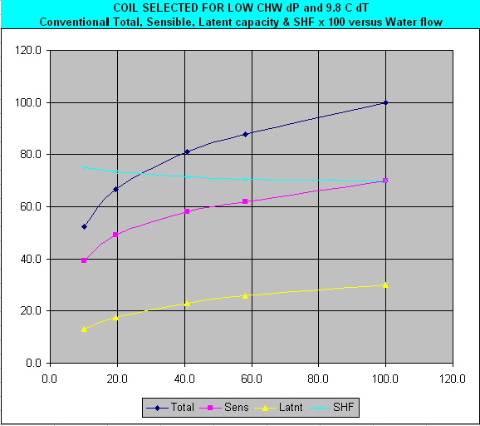
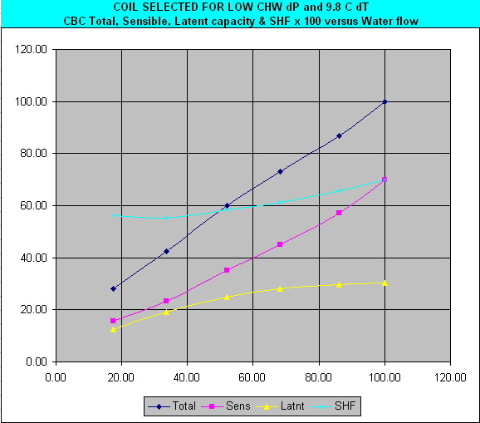
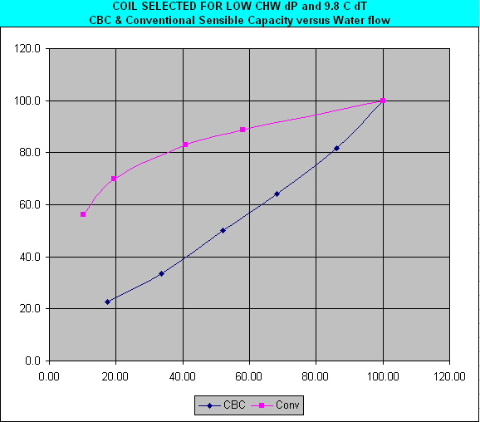
| Page 2. Traditional display of chilled water cooling coil performance against water flow (X Axis) illustrated below. The coil selection is at low full load circuit flow velocity which further degrades the Conventional Coil part load performance. Left to right: Conventional and CBC Coil. |
| The Conventional Coil displays similar characteristics to High ΔP, High Circuit Flow Velocity selection, however now even the Total Capacity ends around 55% minimum at ~ 10% water flow, while the CBC Coil shows near linear Total Capacity versus Water Flow down to ~ 28% Total Capacity at ~18% Water Flow. Sensible Heat Factor trends are the same as before with High ΔP selection. |
| Page 3. Results plotted against Sensible Capacity (X Axis), to illustrate Partial Load Coil Performance versus Sensible Capacity, and aptly so, since stand alone cooling coils without some form of reheat or air bypass are controlled only from space dry bulb temperature deviation from set point. Conventional and CBC controlled coils illustrated below from left to right. |
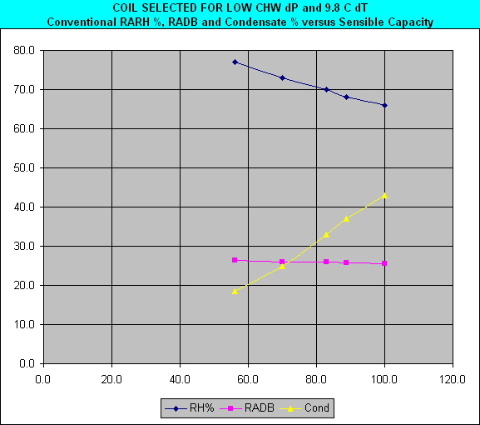
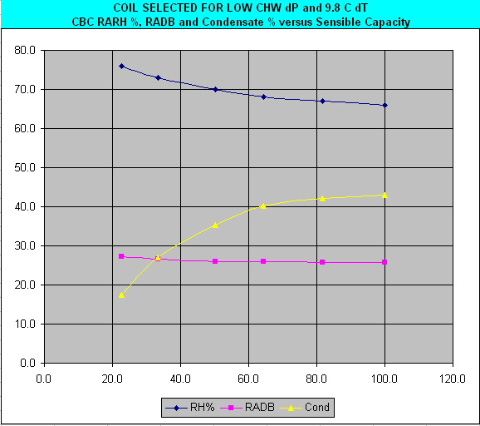
| Utilising Low CHW pressure drop selection, the Conventional Coil minimum Sensible Capacity is around 55%, while the CBC Coil unloads to ~ 22% Sensible Capacity (Limited only by the 6 circuits of coil tested) and exhibits far superior partial load dehumidification and controllability |
| Page 4. Sensible Capacity versus Water Flow (X Axis), also Space RH% and Condensate Quantity versus Sensible Capacity (X Axis), from left to right respectively. |
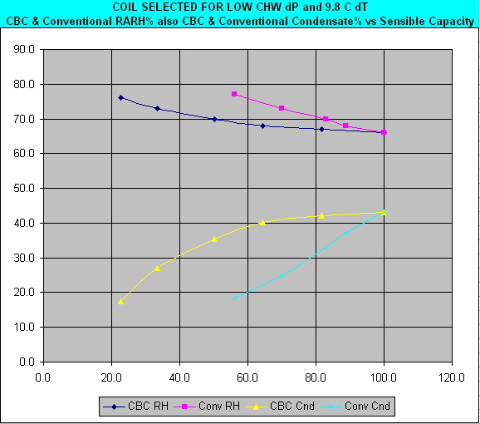
| With Low ΔP
selection the controllability of Conventional Coil below ~55% Sensible Capacity
is a problem, as this particular coil at ~10% Water Flow is still at ~55%
Capacity, while CBC shows near linear Capacity response to Water Flow. Space
RH% of Conventional reaches ~70% at ~82% Sensible Load, while CBC shows
~70% at ~50% Sensible Load. Condensate removal graphs clearly illustrate
the reason for the foregoing. Note: Condensate is collected for 10 minutes after test conditions are stabilised. |
| Page 5. Plotted against Total Capacity (X Axis), to illustrate part load CHW Pump kW, which is proportional to Chilled Water ΔP x Volume. For comparison the Conventional Pump kW is taken as 100% at Full Total Load. The high System ΔP requirement of Conventional Coil is due to the control valve ΔP, which is often 1.5 times of the Coil ΔP to maintain controllability. Conventional and CBC, left to right respectively. |
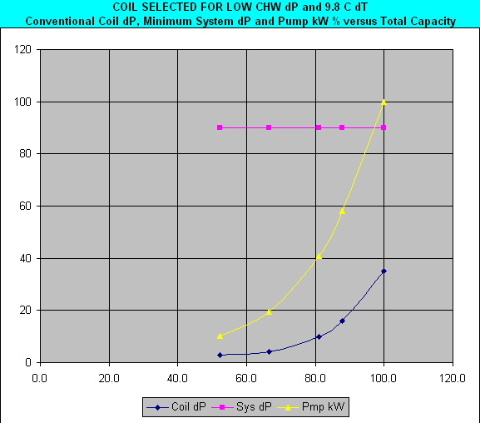
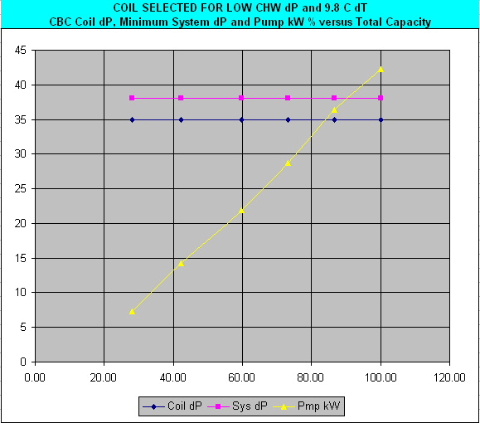
| Note: High ΔP control valve is not required for CBC Controls, in fact the New Generation CBC incorporates the control valve, therefore an external control valve becomes obsolete. For clarity direct comparison of Pump kW requirements is shown on the following page. |
| Page 6. Comparison of Low Pressure Drop Conventionally Controlled and CBC Controlled CHW Cooling Coils, in respect of CHW Pump kW partial load requirements, versus Total Capacity (X Axis). Evidently, equipping this particular coil with CBC Controls, CBC Pump kW reduction is only available above ~72% Total Capacity, below this CBC will in fact use more Pump kW than the Conventional. |
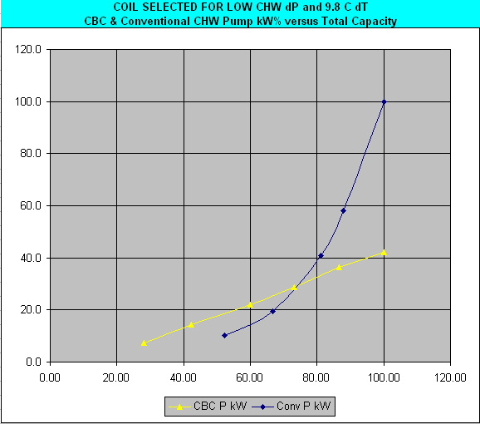
| Conclusion: To select such a low CHW ΔP, Low Circuit Velocity coil with Conventional Controls is not practical, due to its poor partial load performance, while CBC delivers good performance across the whole load range. For fair comparison, High ΔP Conventional and Low ΔP CBC selection is to be compared, as illustrated in the “Energy Saving” section. |